
Decode Hodgeman County Property Tax Records
The most useful record depends on the question you bring to Hodgeman County property tax records. A valuation record explains the taxable base. A statement applies the levies and shows the amount billed, while receipts and delinquency material answer whatever comes up after payment is due.
| Field | What It Shows | Where |
|---|---|---|
| Appraised value | January 1 fair-market value, except agricultural use valuation | County Appraiser |
| Assessed value | Appraised or use value multiplied by the constitutional class rate | County Appraiser |
| Classification | Residential, agricultural, commercial, mineral, or another class | County Appraiser |
| Statement and payment | Amount billed and transaction route | County Treasurer |
| Receipt / delinquency / sale | Payment proof or collection status | County Treasurer by request |
Which record helps depends on the question. The valuation explains the taxable base. The statement applies levies and shows what was billed, while receipts and delinquency files answer whatever happened at payment time.
Start With the Hodgeman County Appraiser
The County Appraiser Cliff Bliss, RMA discovers, lists, assesses, and values real estate, personal property, and oil and gas; the office also handles change of ownership, mapping, parcel maintenance, reinspections, and market studies. Call 620-357-8366 or email appraiser@hodgeman.gov. No public owner, address, or parcel search exists online. There is no downloadable Hodgeman tax roll either. Request the latest parcel record by address or legal description. Ask for the parcel number, class, appraised value, assessed value, valuation date, and any applicable exemption or special treatment. The office's official duties page shows which duties belong with the Appraiser.
No public search form exists, so ask the office directly.
Send Statement Questions to the Treasurer
Treasurer Annette Geier takes questions at 620-357-6236 or hgcotreasurer3@gmail.com. Mail reaches her office at PO Box 247, Jetmore. The Treasurer's page connects to iKan. But the county publishes no public bill-search index, downloadable tax roll, delinquency list, tax-sale calendar, or sample statement.
Ask for each statement by parcel or legal description and tax year. Request receipts, delinquency status, levy detail, and tax-sale facts separately. Do not infer any of these from whether a payment page accepts a transaction.
The official Kansas property-tax payment page opens with a county-name field.
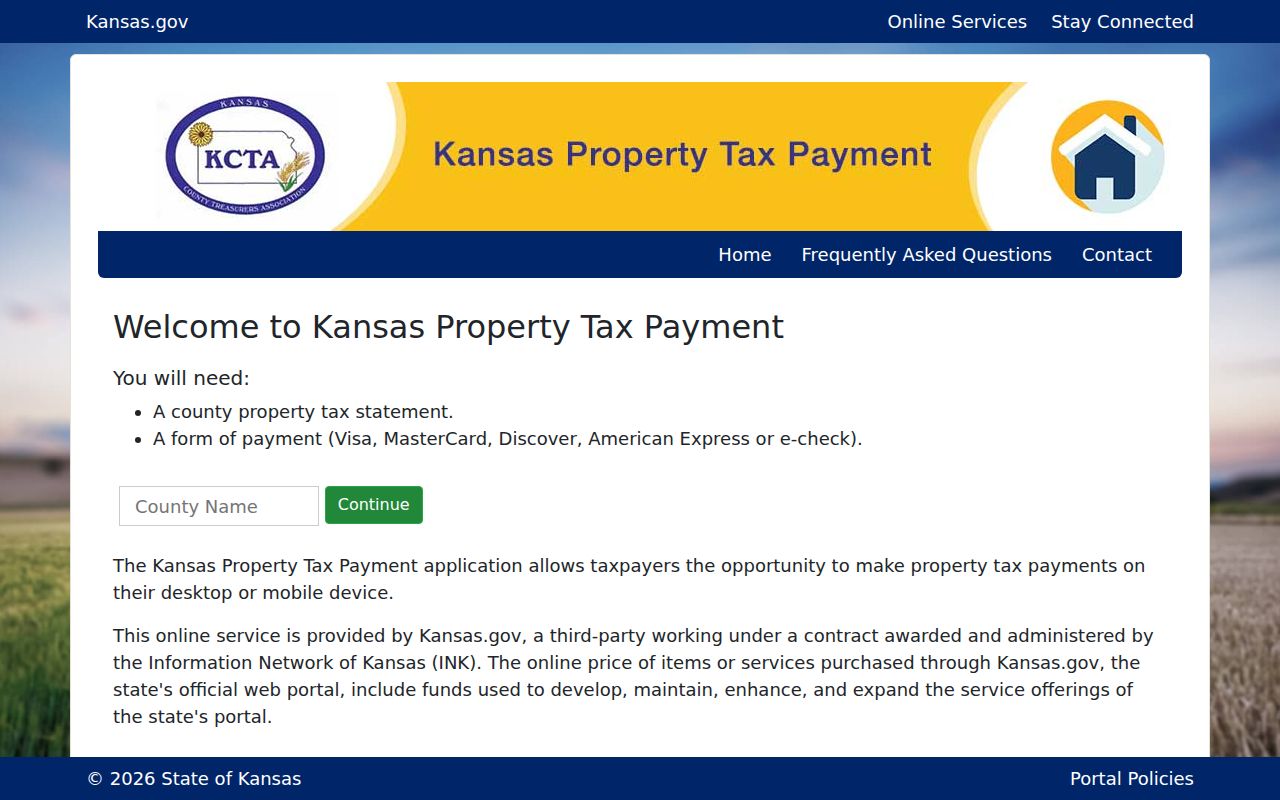
A payment handoff is not a public statement.
Look Up a Hodgeman County Tax Bill
Stick with a single parcel number when checking both the assessor and treasurer so valuation and collection records stay matched.
- Ask the Appraiser to match the address or legal description to the parcel.
- Request the valuation and classification for the relevant January 1 assessment date.
- Give the parcel description and tax year to the Treasurer for the statement.
- Request payment receipts, delinquency status, or sale material explicitly when needed.
- Compare names, descriptions, dates, and years before joining the records.
- Assessed value
- The class-rated portion of appraised or agricultural use value.
- Mill levy
- The collection rate applied to assessed value.
- Exemption
- A legally authorized exclusion or adjustment; eligibility must be confirmed.
- Tax lien
- A claim arising from unpaid tax, distinct from the annual valuation.
Kansas Classes Change the Taxable Base
Kansas assessment rates vary sharply by class. Residential property is assessed at 11.5% of appraised value. Vacant lots sit at 12%. Commercial and industrial property carries 25%, as does personal property, while motor vehicles use 20%. Agricultural land is assessed at 30% of use value, and oil and gas commonly take 25% or 30% depending on class. Actual use on January 1 controls the classification. Mixed-use parcels can carry several classes. These figures are assessment rates, not mill levies or bill predictions, so verify the local class and component values on the county record.
Use Market Studies as Context, Not a Parcel Answer
Hodgeman County publishes market-study material and reviews recent sales and economic conditions annually. Kansas Department of Revenue valuation maps add context. A ratio study is a statistical comparison. It does not give one property's tax rate. The 2024 Hodgeman summary covers agricultural land, oil and gas, residential, public utility, and commercial real property. That breadth is the trap. A countywide average misleads when applied to a single house, farm, business tract, or mineral interest.
Request Delinquency and Tax-Sale Status Directly
Hodgeman County publishes no online delinquent-tax list. There is no public tax-sale calendar or sample foreclosure file. Ask the Treasurer by tax year and legal description. Where litigation is involved, the Kansas District Court Public Access Portal may surface a public foreclosure or judicial-sale docket, and older converted documents may require the courthouse terminal. A docket headline alone proves nothing about final disposition. Compare any judgment, sale confirmation, sheriff's deed, later deed, and recorded release.
Appeal a Hodgeman County Assessment
Start at the Appraiser. Name the valuation year, class, and the disputed evidence. Kansas guidance provides an informal appeal after the spring real-property notice, or a payment-under-protest route when paying the tax. Comparable sales, factual corrections, photographs, and records showing use or condition can focus that review.
Appeal window. Kansas provides 30 days from the spring real-property notice for the informal appeal; payment under protest is an alternative, and both routes cannot be used for the same valuation year.
Prepare Evidence for a Hodgeman Valuation Review
Start with the record itself. The Hodgeman County Appraiser holds the parcel's January 1 valuation. It also tracks classification, land and improvement components, and property characteristics. Request the market-study material behind the notice too. Check use, acreage, building description, and condition. Confirm any sale or parcel change matched the right tract. Keep the notice date, because it starts the informal appeal window.
Comparable sales persuade best on location, use, physical traits, and valuation date. Each must match the subject property. A residence and a commercial tract belong to different Kansas classes. So do farmland and an oil or gas interest. Treat them as one and the comparison collapses. Photographs, repair evidence, or a survey can focus the discussion. So can a corrected legal description or documents showing actual use. None of that substitutes a private estimate for the statutory process.
Skip the informal spring route, and Kansas still permits payment under protest at tax payment. The two are alternatives for one valuation year. Confirm the current form, filing place, and deadline with the Appraiser or Treasurer. The Treasurer handles questions about amounts collected. Value and classification challenges begin with the Appraiser.
Separate a Tax Sale Lead From a Finished Transfer
Hodgeman County publishes no online delinquency list, tax-sale calendar, or sample tax-foreclosure case. Go to the Treasurer instead. Ask for records by tax year and legal description. Request the statement, payment status, delinquency record, sale notice, or receipt. Do not ask for a generalized conclusion about the parcel.
If court action occurred, search the owner, former owners, and parcel-related names in the Kansas court portal. Then confirm the legal description. A foreclosure petition states allegations, while a judgment states the decision. A sale notice describes a scheduled process. A sheriff's deed, tax deed, confirmation, later deed, or recorded release may resolve the land-record question. An old delinquency or complaint does not prove title was lost.
Record each stage in date order. Label its source: assessment year, bill, delinquency, petition, judgment, sale, deed, and later release. The timeline keeps tax years separate. It also ties each court event to the correct tract. For legal status or redemption questions, get the underlying documents and qualified advice. A payment-screen message will not settle title.
Read Countywide Valuation Data Carefully
The Kansas Department of Revenue publishes valuation maps and annual ratio studies. Both give useful county context. The 2024 Hodgeman summary includes agricultural land, oil and gas, residential, and public utility shares. Commercial real property appears too. A ratio study compares appraised value with total selling price. It is statistical only. It is not a parcel-specific tax rate. It is not an individual appraisal or a prediction of any particular bill.
Which property class applied on January 1? Did mixed uses create more than one component? Ask what physical or market data changed, and which tax year the Treasurer's statement carries. A farm, an oil-and-gas interest, a vacant lot, a residence, and a commercial building all respond differently. The same county market drives each of them.
Sale price needs a source label too. A deed may state consideration. The Appraiser may keep a sale field. A Sales Validation Questionnaire may accompany a conveyance or qualify for an exemption. Under KRODS guidance the SVQ is not filed of record. It is destroyed after five years. A transfer-on-death deed requires no SVQ because it creates no present transfer. So never assume a recorded consideration line, a reported sale price, an appraised value, and an assessed value are the same number. Or that they measure the same event.
Track one row per valuation date and tax year. Each row should capture classification and appraised and assessed value. Add levy details, bill amount, payment status, and source date. Log parcel splits, improvement changes, exemption decisions, and ownership updates separately. The pattern then shows whether value, class, levy, parcel configuration, or payment timing drove the change. The result is not blended figures.
Corrections go smoother with specifics. Quote the field you believe is wrong. Attach official or property-specific evidence supporting the change. Ask the office to identify the record date. Ask for the response path too. Finally, keep the original notice and its envelope. The appeal clock runs from the notice date rather than a later search.